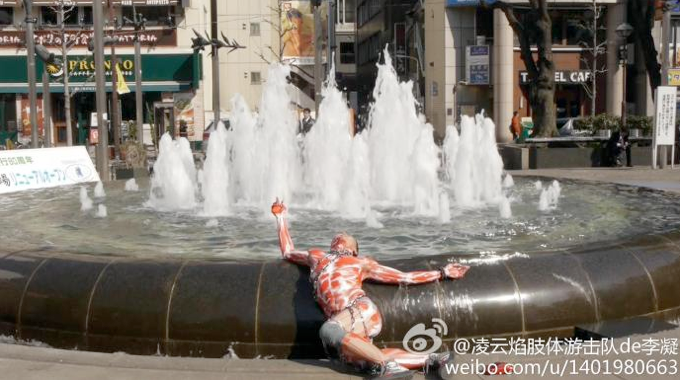


During r:ead’s second period of stay, I felt the potential of art even more. In the first period of stay, I could only get a very superficial impression of Japan. But now something evolved that strongly appealed to me. Most important is that I myself underwent a change. I decided to watch this closely and record the process of my own change in the form of a film. It is a film that observes a change of mind.
When r:ead’s first period of stay finished and I returned to China, the relations between China and Japan were very tense. As an artist with ambition, I thought that I could make use of this situation to make a performance. I wanted to leave my mark on history and art history. At this time, I was a bit silly! I thought it was enough to just stir up sensations, no matter whether the idea was right or wrong, whatever the result was. You could say that the beginning of the film depicts my true inner state. I, a Chinese national, a young man of patriotic mind, would create a performance at the Yasukuni Shrine and irritate “Japan” – hoping to provoke. But what I saw after I had arrived in Japan was a pretty city, and Japanese people working hard and devotedly, and enjoying their lives. Many Japanese also do not conform to their government, a fact that gave me a positive impression of Japan. By this, my general idea of “Japan” that had been vague, unsophisticated and abstract, dissolved, while a concrete interest in individuals arose. And “I” gradually lost my goal. By coming into contact with more and more Japanese people, from elderly people who experienced the war to pure youth, I realized that all of them have thoughts that are intense. This is due to the strength of education. During the war and today, education has always been consciously and constantly controlled by the state or the government, especially in times when the content of the education is questionable. An 88-year-old man said that he does not like China. But this is because he was taught in school that China is a bad country and that the Chinese are lesser beings. Some 13-year-old boys said that they did not know much about the Sino-Japanese War. Behind the educational system stands the control of the state. I gradually opened my eyes. It is not that the Japanese are brutish, but that all humans have a brutish side, a madness. They are controlled by the state which utilizes them at those points where their humanity is weakest. A countless number of citizens are lost in the hell that is war…
When I was watching a performance by Butoh master Min Tanaka, I was utterly lost in contemplation. Because Tanaka’s body and my own body are so similar, I felt as if I had been on stage myself. I could see myself in twenty years’ time.
The Red Army soldiers during the Cultural Revolution did not at all differ from the Japanese Imperial Army. Talking to my mother, she told me about the time when she, as a member of the Red Guards, saw Chairman Mao on Tiananmen Square. “We were also following the doctrine of Mao Zedong passionately and we did brutal things.” By reading over several documents, I learned that many historical facts had been hidden by the Chinese government, such as the Sino-Japanese War. The Kuomintang initiated the war, which led to tragedy, but in the anti-Japanese TV dramas that are broadcast today one after the other on Chinese television, the narrative has it as only the Communist and guerilla armies attacking the invading Japanese army. What has the present Chinese government given the Chinese people? Pollution, forced evictions, fraud, brainwashing… By this time, my ambition and wish to become “famous” had already collapsed…I don’t want to be an accomplice in a state crime, I don’t want to become a marionette of the government. To start with, I gave up my plan to perform at Yasukuni Shrine. The choice of this place is not my own unique style of expression; I would merely be a tool of the government. Instead, I would do a performance in an ordinary part of the city for regular people – with a different topic and in a different style. This is the force of my art, this is the artistic approach I chose.
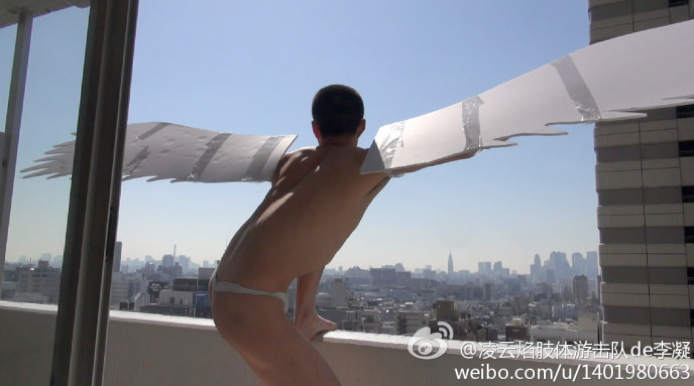
“The Chinese and Japanese people, don’t let somebody turn you into a marionette!” For the final scene, as a symbol of freedom I fitted myself with wings, standing on top of a high-rise building in Tokyo, looking up at the sky and the city below.
“History will probably not remember me. But what is ‘history’? It is something created by the victors. What we really need is clean air and food.”
The film is shot from a first-person perspective and tracks the real-time changes of my mental state, but the viewers can also easily synchronize themselves with it. For me, it is very meaningful to create a work like this, especially with the current situation between China and Japan so tense. I hope that I can contribute a little to the “undoing” of prejudices and misunderstandings between nations, to the interaction of individuals, and to the search for self-reflection and sincerity which lie in human nature.
During the creation process in Tokyo, I received great support from many people, including Hitomi Oyama, Shiryu Kyo, Ulrike Krautheim, Kaori Yoshizaki, and Chiaki Soma. Thank you very much.