


image of the voices: listen and talk

Jisun Kim is attempting to cross boundaries around rigid social system and seeking a kind of “resisting gesture” in its interspaces, and she has experienced the greatest flavour of representative democracy—the election—in two cities, Tokyo and Seoul. Regarding to virtual spaces that she has been engaging with so far, this experience threw up the issue of a new platform for democracy. The possibility as for a new democracy without communication that Hiroki Azuma describes in General Will 2.0 generated an important keyword for this second residency. The r:ead participants, coming from four different countries, all spoke about the crisis of democracy in their own country. In this context, Azuma’s ideas certainly show a fascinating new potential for politics that goes beyond language and nations. Azuma’s recent tweets reacting to the statement of Osaka mayor Toru Hashimoto’s remarks that “the comfort women were necessary” were for a while discussed in Korea as Azuma’s “rash remarks”. What might he think about that? At international events, English is often used as common language, under the implicit premise that communication otherwise is impossible. But during r:ead each participating team could speak in their native language. Instead of being confronted with the barrier of imperfect communication, we gained the scope for an attempt to cross borders of each cognitions and practices. As a result, I think it became possible to read our invisible differences and conduct mutual dialogue. In fact, we had the chance to meet several people, including the Korean translator of General Will 2.0, An Chun, and due to their intellectual achievements leave behind our knowledge so far and decipher Japanese society.

During the first presentation in Tokyo, Jisun and I talked about “anonymity”, the theme we wanted to research during the residency. Jisun developed her thoughts using the form of a portal website. After the presentation some people said that we should be careful about the negative effects of anonymity. Examples of the manifestation of online right-wing fascism (netto uyoku), the regrettable death of Aaron Swartz, and “hacktivism” (a combination of the words “hacking” and “activism”), and the borders between sharing and possessing, independence and attack, resistance and illegality online were also all much discussed. But considering this problem, rather than the aspect of controlling conflict and danger, I want to think about its necessity in the dimension of structuring the world. The words Ingyeo or Dutbojab (literal translation: things neither seen nor heard) were born on the internet. Assuming that exclusion is caused by expert knowledge of the level of awareness of reality, the restriction of authority, and an increase in expenses, we naturally should regard the database of the existence of such “unconsciousness” as an element to supplement the existing democracy.

The Korean literary critic Do-hoon Bok writes in The Four Knights of Apocalypse, based on the famous painting by Albrecht Dürer, four analyses of today’s world that faces catastrophe. He says the four knights stand for the history of self-destruction of capitalism, the danger of the political imagination which divides between friend and foe, the barbarous battle for equality and inequality, and ideological sphere of biopolitics where the values of life and death got lost and only existence itself exists (an important principle that Michel Foucault refers to in his book “Discipline and Punish: The Birth of the Prison”). Jisun Kim’s “Well-Stealing”, a subversion of “well-being” as a cross-section of Korean society, is connected to the scale which the third knight is holding. The threatening idea, that we have to be advantageous compared to other people—that we must not lose—eliminates the elements that threaten our life, but by this also eliminates life itself. “Well-being” is the face of a different existence, where the method of survival itself forms the goal—end. Maybe Ingyeo is the people who have been left out of this existence. Going back to the metaphor of the apocalypse, these people are neither “subjects” of a feudal society nor modern “subjects”, nor somebody whose life could be called “anti-modern”. We tried to connect them to Hiroki Azuma’s “humans as animals” and Jisun Kim’s “Ingyeo”. When Jisun tried to find their faces, she went beyond the scope of the internet by meeting Hajime Matsumoto and his neighbors who are running second-hand goods shops in Koenji, and the others who are gathering at the Genron Café. Following this process, she stole the format of the quiz from the Genron Café. A quiz is a conversational platform that comes to shape by answering questions and demonstrates a mechanism of making the existence of strong connections to self-awareness and enlightenment the subject. Jisun created a quiz that aims at the disturbance of minds heading towards the right answer, though there is no answer—while knowing that she would fail. Coincidentally, the day of the final presentation was March 11th, the other day when two years ago the Great East Japan Earthquake occurred so that made a catastrophe scenario visible to the whole of East Asia. The countries of East Asia are involved in one part of this apocalypse—the past, present and future. Can we find a new paradise in East Asia? We are still uncertain about the answer to that question.

During our interview, Hiroki Azuma said that he worries that “people from outside who criticize the swing to the Right in Japan in diverse social dilemmas invite controversy about interference in domestic affairs, and merely feed opposition”. He also said that the problem of Japanese society is that it has no problems. These two comments made me think of the naïve attitude of intellectuals, as well as the non-political tendency of Japanese society. They do not want to debate issues from the viewpoint of critical awareness or the experience of democratization. Politics means a time and space where different values confront and become aware of each other. The most relative result of this space is what we call today’s democracy. A paradise where we continue talking about enemies without avoiding them, where we turn a constellation of opposition into neighborly friendship. Does that not exist? At this point I recall what I heard from the neighborhood gathering at the Nantoka Bar in Koenji: Yeah, somehow by all means, at least, in the end, they are unclear about democracy, politics and the sphere of society. Why? Is it not only democracy but also the art of modernism and contemporary art that have been implanted in such a very short time—without paying the bill? Are therefore some outstanding artists trying to pay the bill and with their activities follow the lines of political correctness? Can they pay the unpaid bills only by this kind of social intervention? The theatre producer Yasuo Ozawa remarked in our interview that he sees no publicness anymore in theatre and is therefore trying to find a new platform for theatre through online. It might be happened in virtual or different places—but at any rate, seems quite sure that arts need society. We still do not know the method of how to pay the bill but I hope that we continue committing the problems to remembering, without being romantic about the fact that we do not have a solution. Not even in five years when —as we said—we will meet again.
On “Oral History”

For r:ead I started a project named “Oral History”, a project in the form of interviews with passersby on the street that asks people to talk about their knowledge of Japanese history before and during World War II. We conducted guerilla interviews with about seventy people in the areas of Ueno Park, Ameyoko, Yoyogi Park, Shinjuku, Tokyo Tower, Shin-Okubo and Asakusa. To keep the identities of the interviewees hidden, we filmed only their mouths with a video camera, creating, as the title suggests, a situation where “mouths” (oral) tell “history”. I worked on the project with the idea to develop it further into a film.

For r:ead’s final presentation, I firstly attempted to place what the interviewees said into chronological order, and then presented the material which I tried to edit in this way. Through this method of editing – organizing the memories evoked by seventy individuals into one single timeline – I was hoping that the shape of a shared awareness would become visible, as well as those facts that had been left out. The result was that, for example, the terms “the dropping of the atomic bomb” and “attack on Pearl Harbor” were repeated by many more mouths on the timeline and by this, I then understood that they are much better known than other historical facts. It is also a very interesting phenomenon that several people say “nuclear power plant” (genpatsu) instead of “atomic bomb” (genbaku). As this kind of verbal errors and false memories were articulated by a number of people, I saw that something like a collective unconscious emerges. I felt the core of this project was to depict the moments when this kind of unconscious emerges on film.

But what I recognized by editing the material in this way was that putting the material in chronological order could not effectively display those verbal errors and false memories. This is not a work that aims precisely to convey the history stored in people’s memories. The real challenge is to record the distorted form of errors and gaps in collective memory and historical awareness. Therefore, I believe, the decisive point will be a question of how to fit the utterances that came out of the great majority of people’s mouths – “I have no clue” or “I am bad at history” – the absurd statements into the systematic order of the timeline. I feel that if I just discover a system for this I can attempt to film many more interviews and by gaining more and more material, achieve a deeper and more sophisticated level of expression.

The final form of this project is not yet visible to me, but it is not my wish to present it in the form of a multi-channel installation or an archive. Instead it is my dream to put the entire material into chronological order and to finish it as a single-channel work, and then show it in an ordinary cinema: To unilaterally and obtrusively force onto viewers sixty minutes of mouths full of historical contradictions, distortions and stupidity. I feel that this form in particular might display the shape of a sincere “Oral History” created by the reality of Japan today.

April 26th, 2013

Undoing

During r:ead’s second period of stay, I felt the potential of art even more. In the first period of stay, I could only get a very superficial impression of Japan. But now something evolved that strongly appealed to me. Most important is that I myself underwent a change. I decided to watch this closely and record the process of my own change in the form of a film. It is a film that observes a change of mind.

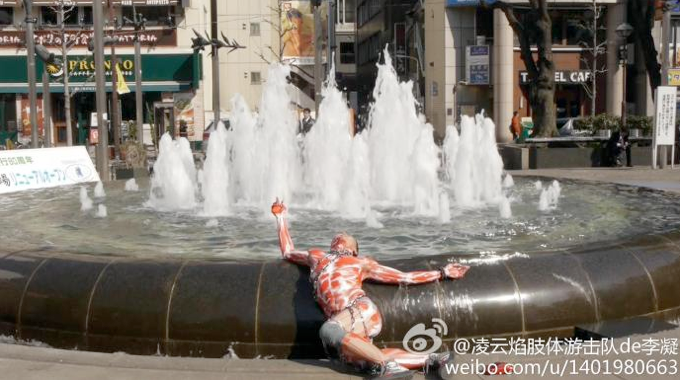
When r:ead’s first period of stay finished and I returned to China, the relations between China and Japan were very tense. As an artist with ambition, I thought that I could make use of this situation to make a performance. I wanted to leave my mark on history and art history. At this time, I was a bit silly! I thought it was enough to just stir up sensations, no matter whether the idea was right or wrong, whatever the result was. You could say that the beginning of the film depicts my true inner state. I, a Chinese national, a young man of patriotic mind, would create a performance at the Yasukuni Shrine and irritate “Japan” – hoping to provoke. But what I saw after I had arrived in Japan was a pretty city, and Japanese people working hard and devotedly, and enjoying their lives. Many Japanese also do not conform to their government, a fact that gave me a positive impression of Japan. By this, my general idea of “Japan” that had been vague, unsophisticated and abstract, dissolved, while a concrete interest in individuals arose. And “I” gradually lost my goal. By coming into contact with more and more Japanese people, from elderly people who experienced the war to pure youth, I realized that all of them have thoughts that are intense. This is due to the strength of education. During the war and today, education has always been consciously and constantly controlled by the state or the government, especially in times when the content of the education is questionable. An 88-year-old man said that he does not like China. But this is because he was taught in school that China is a bad country and that the Chinese are lesser beings. Some 13-year-old boys said that they did not know much about the Sino-Japanese War. Behind the educational system stands the control of the state. I gradually opened my eyes. It is not that the Japanese are brutish, but that all humans have a brutish side, a madness. They are controlled by the state which utilizes them at those points where their humanity is weakest. A countless number of citizens are lost in the hell that is war…

When I was watching a performance by Butoh master Min Tanaka, I was utterly lost in contemplation. Because Tanaka’s body and my own body are so similar, I felt as if I had been on stage myself. I could see myself in twenty years’ time.

The Red Army soldiers during the Cultural Revolution did not at all differ from the Japanese Imperial Army. Talking to my mother, she told me about the time when she, as a member of the Red Guards, saw Chairman Mao on Tiananmen Square. “We were also following the doctrine of Mao Zedong passionately and we did brutal things.” By reading over several documents, I learned that many historical facts had been hidden by the Chinese government, such as the Sino-Japanese War. The Kuomintang initiated the war, which led to tragedy, but in the anti-Japanese TV dramas that are broadcast today one after the other on Chinese television, the narrative has it as only the Communist and guerilla armies attacking the invading Japanese army. What has the present Chinese government given the Chinese people? Pollution, forced evictions, fraud, brainwashing… By this time, my ambition and wish to become “famous” had already collapsed…I don’t want to be an accomplice in a state crime, I don’t want to become a marionette of the government. To start with, I gave up my plan to perform at Yasukuni Shrine. The choice of this place is not my own unique style of expression; I would merely be a tool of the government. Instead, I would do a performance in an ordinary part of the city for regular people – with a different topic and in a different style. This is the force of my art, this is the artistic approach I chose.

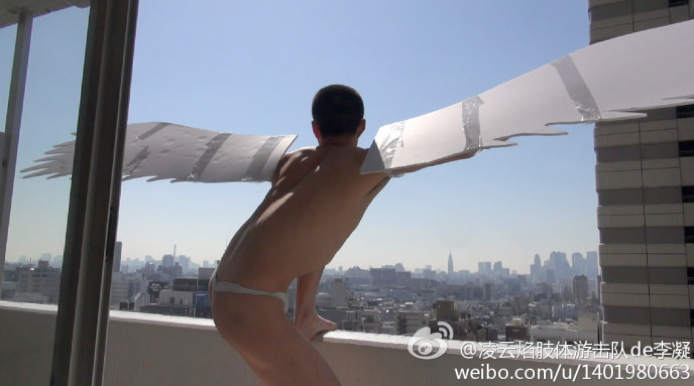
“The Chinese and Japanese people, don’t let somebody turn you into a marionette!” For the final scene, as a symbol of freedom I fitted myself with wings, standing on top of a high-rise building in Tokyo, looking up at the sky and the city below.

“History will probably not remember me. But what is ‘history’? It is something created by the victors. What we really need is clean air and food.”

The film is shot from a first-person perspective and tracks the real-time changes of my mental state, but the viewers can also easily synchronize themselves with it. For me, it is very meaningful to create a work like this, especially with the current situation between China and Japan so tense. I hope that I can contribute a little to the “undoing” of prejudices and misunderstandings between nations, to the interaction of individuals, and to the search for self-reflection and sincerity which lie in human nature.

During the creation process in Tokyo, I received great support from many people, including Hitomi Oyama, Shiryu Kyo, Ulrike Krautheim, Kaori Yoshizaki, and Chiaki Soma. Thank you very much.

First Experience: Ning Li – In Search of the “Changeling” in Tokyo

When the artist Ning Li came to Tokyo, he brought with him the characteristic dustiness of his hometown Jinan, as well as the psychic stress, the discouragement, anger, and resignation of life particular to the current government of China.

For a Chinese national today, “Japan” is no doubt the emblem they know best. The thoughts towards Japan that Chinese people have refer to the war that took place 1937 and 1945. In films and television dramas, the image of the “Onigo” (“changeling”, a pejorative term for the Japanese) has taken society by storm and gradually implanted a stereotype into people’s minds. (In the past, “Onigo actors” were skinny Chinese actors playing the roles as vulgar characters but recently it has been more young Japanese actors who live in China.) Ning Li has been searching for the “Onigo” in Japan, but the only people he could find are people diverse in sensibiltiies and personality, and who have the same human emotions as him. The stereotype he had in his mind has lost its shape. At this point he then developed his concept of “Undoing”.

Naturally, the structure of the work is relatively simple but in the current situation between China and Japan, a work like this is experiencd in a very particular way. Ning Li, as he shows in the beginning of the work, ironically points to an empty, narrow-minded Chinese nationalism. His perspective, though applying different methods, also represents an ironical parallel with Makoto Aida’s approach to Japanese nationalism.

The categories of “state”, “ethnic group” and “race” are “undone”, and the position of the individual strengthened, so that the individual is not absorbed by the group any more.

There is a popular funny story. The theme for a short essay in an English exam was: “Write about your personal view on the problem of food deprivation”. The African students asked: “What is food?” The American students asked: “What is deprivation?” And the Chinese students asked: “What is a personal view’”? In China, where collectivism is esteemed, individual principles are systematically destroyed by the educational system, ideology and habits. As an artist who is living under the strong pressure of this system we can understand that Ning Li is rebelling. Looking at his initial works, its form is comparably simple and superficial. But this is no doubt due to the fact that there have been limits of time and scale. Yet what is even more important is that his theme is the collapse of the group, the wiping out of stereotypes and categories, but his research and its methods still rely on categorization. This means that when he decides on the age of the interviewees for his film he expects that these person will be representatives of his or her age group. For example, he asks: “How are you Japanese thinking about this issue?” “You Japanese junior high school boys, what do you like?” When he asks questions like this, he wants the interviewed person to answer as a representative of the group to which he or she belongs, and the questions undoubtedly include a kind of induction. By this, a precious opportunity for true exchange between individual and individual becomes ineffective; the interviews remain on the surface. And this is contrary to the artistic aim of Undoing. Without the limitation of time, Ning Li’s interviews would surely have come reached a higher standard.

Actually, since the 1980s Chinese artists have emphasized the role of the individual and worked to weaken collectivism. The dark shades of the civil movements during the Cultural Revolution still continue to shroud people’s minds. The pressure of mainstream discourse under the current system created a backlash which made Chinese contemporary art of the last thirty years opposed to the issues of social responsibility and the politicization of art. Ning Li’s way of thinking basically follows this same track. It is like a hand-me-down opinion from the 1968 student movements in the West, but when we take the specific circumstances in China into account, we can say that this kind of resistance can still claim value.

The foremost aim of r:ead is exchange. The very first unconscious step of cultural exchange is to escape from stereotypical images and to eliminate the prejudices against certain ethnic groups, and to deal with each other, individual to individual. In this way, deepening the exchange between individuals, deeper thinking will finally be generated. More than thirty years have passed since the policies of reform and openness began. China is still a relatively closed state. Especially for a Chinese artist r:ead was a most valuable experience.

History Repeated by Democracy II – Resetting History

During the second period of stay I brought up the topic of how history had been repeated due to democracy. I did so because the date of the final presentation was March 11th, 2013. On that same day in 2011, a part of Japanese history was reset, and many things were planned and valued anew from March 12th. And then in the 2012 lower-house election, Shinzo Abe was elected prime minister once again. Five years ago in 2007, when he was prime minister, March 11th had been just an ordinary day.

For my presentation, I prepared newspaper editions from March 11th, 2007 – the Asahi Newspaper, the Mainichi Newspaper, the Yomiuri Newspaper and the Nikkei Newspaper. I divided my presentation into two parts: The newspapers were first exhibited and then later read out by the attendees. The participants read the name of the newspaper, the date and article chosen by themselves. Through this, March 11th, 2007, was repeatedly emphasized, bringing to the fore little by little the difference between the years. For example, in international politics at that time, America was still under the Bush regime, mobile phones were a comparatively older design, and advertisements for construction companies were still full of hope. Questions were also raised about resolutions for the issue of the wartime comfort women and the attitudes of China.

When I heard the people reading out the texts, I not only felt a kind of nostalgia, I was also astonished how many things I had forgotten. We tend to think our memory is perfect when we evaluate things, but this is a strange thing to think. Nobody knows what he or she was doing five years ago on a certain day.

On March 11th, 2011, a part of Japanese history was reset, but this sort of resetting is exactly what art creators have to attempt to do in their work. They can pull audiences into a situation, where planning and evaluation are conducted anew and the creators themselves are reset every time, collecting new material and then engaging with the next work. Through the residency, the artists and curators were “reset” to a certain extent. Due to this I hope for dialogue on what kind of new works they will create in the future.

Towards a practice of history going beyond politics

At first I was interested in how the goal of this project “to share awareness regarding the problems of society and art in East Asia” could trigger new perspectives through the participants confronting the concrete situations of their own countries. But, on the other hand, I was also a little concerned about how the history and political situation of East Asia, whose countries are interconnected through mutually complex relationships, would affect the platform of our dialogue. Once the system of “state” gets involved with this project’s aim of building up a platform, the participants must be aware of the relation to their nationality and state. In this situation, their subjective views are identified with those of the respective states and the dialogue between individuals quickly turns into a dialogue about the interests of states and an endless argument on “justice”. However, I think that the participants were – as these conflicts are comparatively intense right now – carefully exploring how they can act as one person engage with the cultural sector without being absorbed by the dynamics of politics.

The residency was divided into two periods of stay. First, we discussed the themes and interests that form the axis of every artist’s activities. Next, in various situations and through various approaches – presentations, film screenings, shared meals and train journeys – we shared the research that every participant was conducting in Tokyo. What was interesting about this process was that the shared experiences the participants had during their short stay in Japan came to be an occasion for relativizing one’s own interpretation of and internal response to Japan, and regard it from a more objective perspective. Of course, this held true as well for Meiro Koizumi and myself, who reside in Japan. I feel that, like Jinjoo said in the final presentation, the experience of how much you don’t know of the other, although you thought you knew him or her very well, generated a disparity throughout the process. Or rather, to pull out the discourse and feelings on Japan that oneself has internalized from my own subjectivity – they are one’s identity strongly connected to discourse, history patriotism, and democracy, and how this is all connected to exclusivity. This became an occasion to become aware of that.

During the research period, Meiro Koizumi conducted an experiment with film. He did interviews with people at various locations in Tokyo, asking them about Japanese wartime history. When they were speaking he filmed only their mouths. As the interviewees remained anonymous, we could see stories, information, beliefs and emotions, as well as “absence” like disinterest and ignorance – all told in an undisguised manner. While I watched this random manner of talking, I could not help but focus my thought on the question, “What is history?” There is intense controversy over historical issues between states, ranging from territorial questions to the content of school textbooks. In times of globalisation when it is necessary to maintain an imaginary collective of the state, this becomes an increasingly important tool, but on the other hand, it is fair to say that for the market-driven life of the individual, there is almost no necessity to confront the past in the shape of “history”. Nevertheless, in the midst of various history-related discourses rising and falling through the diversification of media, we should not overlook the fact that even if this history does not generate individual experience directly, it has the capability to stir up strong hate and exclusion of the “other”.

I believe that Meiro Koizumi’s experiment raises one important question this residency project will have to consider in the future. This is the question of whether, in order to create future connections in this area, sharing awareness of artistic and social problems in East Asia can provide a space for verifying the discourse and subjectivity of oneself and the other, directed towards history as a new practice of knowledge, such as moving beyond the scope of states and politics. Going forward, when not only East Asia but the entire world will probably be more mobile, the creation of a space where inner negotiations of oneself and the other become possible is an issue that not only this project but culture-makers in general will have to think about.

What comes after

To believe that you know something exactly is perhaps dangerous. At least, it is for me. In Jean-Luc Godard’s “Film Socialisme” [English title: “Socialism”], children say they won’t speak to people using the verb “to be” and instead try to use the verb “have”. During the residency period, I made an attempt to leave behind the potential for a new system by avoiding using the verb “to be” with regard to a number of keywords and Japan.

Keywords
The ideas that occupied most parts were “democracy”, “virtuality”, “mental cosplay”, “Otaku”, “surplus”, and “catastrophe”. As I wrote in my previous text this was because the presidential election and the Mayan prediction of the end of history at the end of last year had generated a strong disbelief and reflection on the system, and a peculiar power of imagination. At the same time, I was interested in the abundant energy created by this situation.

Research
At the start we conducted our research through interviews we had been setting alongside our thematic keywords. The interviewees were Hajime Matsumoto, Yasuo Ozawa, Hiroki Azuma, and Joo An. Furthermore, we participated in events at the Genron Café, which is run by Hiroki Azuma, watched performances, and did research by hanging around in several areas of Tokyo. But the more we evolved, the more the keywords we had in our minds at the beginning were dismantled and becoming useless. (This is what I thought at that point in time.)

Presentation
When I had to make a public presentation of the process that was not yet structured in my own mind, I was not sure about the form for the presentation, as it was still the first stage of the creative process. Moreover, much of what I had been researching for this program in advance had lost its shape after arriving in Tokyo. As a kind of last-ditch measure, I remembered a quiz that I had seen at the Genron Café and had found interesting. I made a collage with my own questions, but if I am honest, I do not really know what meaning it was supposed to have.

What comes after?
In the beginning, it seemed a little vague to me what the outcome could be after two residency periods of respectively one and three weeks. But when I returned to Korea a few things became the opportunity for some ideas that had existed solely like islands to finally come together. Based on this, I am now working on a new project together with a travel agency that offers nomadic tours without moving. I will not explain my new project that was born out of r:ead. I prefer to show an image rather than words. A quiz….?

Understanding/Thinking through Encounters

I am very glad that I could participate in r:ead for two weeks in March 2013. I am always busy with preparing exhibitions so this was a rare opportunity for me. The small but precise and deliberate residency created – more than other residencies I knew of – the opportunity for an “encounter” that sticks in the memory, and for exchange in a true sense. Speaking from my ten years’ experience as a curator of contemporary art, there are many opportunities to get to know artists or other curators, but places where you can engage in exchange on a high level are less than you would think. This is even more due to the fact that our work becomes more and more stereotypical.

In general, the encounter between curator and artist often starts with a work. But r:ead consciously and purposefully turned around the model of the “curator-artist-artistic creation process”. This not only had a very special meaning to me, it also matches with the direction of the approach and development of the independent art space that I am currently running, The Cube Project Space. That is, the exploration of ways to develop long-term collaboration with artists.

Chia-En Jao and I participated in r:ead, which gave us this kind of opportunity. There was dialogue between the four Asian countries China, Korea, Japan, Taiwan – and in this frame I truly felt the uniqueness of interchange that went beyond existing geographic interpretations, and knowledge relating to history between neighboring countries and culture. In this process where persons who were strangers at the beginning gradually started to understand each other, we could further develop our cultural viewpoints through communication and debate. These viewpoints vitalized the perceptions and actions we usually take for granted.

This dialogue supplemented what is lacking most in our current work and production processes, the “real-experience”. Over the two weeks, from various perspectives we thought about the Second World War, the history of the Cold War in Asia and the present, where regional economies are globalizing. While this includes a countless number of historical memories, we shared our experiences as a single contemporary human being, from the experience and angle of one living individual. And through this special occasion we asked ourselves if in the so-called “era of globalization” the earth really has become flat, and by that we caught a glimpse of a different worldview.

I felt that the project Chia-En Jao worked on in Tokyo was also a concrete reaction to the experience and thoughts described above. Through observing Japanese history and democracy he confronted the questions the project participants raised through a kind of nonlinear interrelation and dialogue. (In the final presentation on March 11th, he let the participants select and read newspapers from March 11th five years ago, and through this exhibited his views on history and experience.) And with this methodology he also invited the non-Japanese participants to indirectly reflect on their own democratic experience and our relationship to other regions in Asia.

The theme of Chia-En Jao’s project was the re-rethinking of “democracy” and “history as repetition”, due to his observation of immanent changes in Japanese society following the 2012 general election and the Fukushima nuclear power plant accident. But this actually is a topic that not only relates to Japan but also in a broader sense mirrors a common problem/crisis faced by contemporary society as a whole. Therefore we could see that our mutual “relationship” from first to last is interwoven. We learn how much we are depending on each other, not only in the past but also in the present capitalist economy.

For his project, Chia-En Jao’s strategy was the creation of a time process that emerges through displaying and enlarging a visualized material (past newspaper articles). By this he exposited his question. The result of his observations was that history repeated through democracy. Simultaneously, due to this inquiry Chia-En Jao confronted us with – that is, the topic of his re-thinking – he invited every single participant to think together with him, and thus initiated even deeper reflections and responses.

During the presentation the participants did not understand at first why they were holding newspapers from the past in their hands, but through the readings one after another and their mutual reflection, they became aware of Chia-En Jao’s intention of a “space for re-thinking”.

Chia-En Jao’s project is like a foreword. During the two weeks’ residency in Tokyo and through debate and exchange, we started to think latently about the changes to Japanese society after the Great East Japan Earthquake. Further, from what I saw and heard during short trips to Osaka, Kyoto and Yokohama, I understood that actively reflecting on society is increasing now in Japan. For example, Meiro Koizumi’s work shows that too. More and more people from the younger generation are connecting with artistic and cultural creativity, and engaging with social activities. We could say that this observation is the most important harvest for me following the residency. From r:ead I learned about the possible significance of a new model of artistic production and its praxis.