(简体字) 从“缺席”开始

Sorry, this entry is only available in 简体字, Japanese, 한글 and 繁體字. For the sake of viewer convenience, the content is shown below in one of the available alternative languages. You may click one of the links to switch the site language to another available language.

 12月22日早晨,从曼谷归来,在羽田机场一落地便直接前往靖国神社。接着,直接在神社的鸟居前面与下道基行碰头。他刚刚结束了持续了一周的READ旅居创作计划,而我由于一直在曼谷而无法参加。看到满地飘落着金黄色的树叶的大银杏,便让人深感今年日本的冬天已经来临。这个地方同样与全年如夏的泰国竟然同属亚洲区域,这是非常让人难以置信的。在这几年中通过参加着与亚洲各国有紧密往来的活动,我一直在思考,此处的“亚洲”究竟是一个怎样的概念。

 目前我参加的READ是与东亚各国艺术家及策展人将“进行对话交流的场所”作为“在一定时间内招募各种艺术创作者并在旅居期间创作出作品”活动的一种新形式,也是一次充满挑战性的尝试。由于我平常主要作为艺术中心的策展人,对思考这个新居留计划框架的机会非常感兴趣。我所属的单位是专门负责创作的工作室,这里住宿设施齐全,也有发表会适用的展示场地,或许可以说这里是所有创作活动的集中处。对艺术家来说,这种将作品集中进行创作之后发表的纪念碑式活动将成为大前提。其意义之重是毫无疑问的。而我认为此次的READ,并非由于其纪念碑式的意义而被固定为一个明确的目的,而是为了探讨其在居住期间创作自身的意义,或者作为对此刨根问底的一种备用环境。

 此次同组的艺术家下道通过不断努力,对纪念碑、纪念碑式事件以及其类似或内部出现的情景进行原因的探求。据了解,他是在第一次旅居创作交流之后,发现了“约见场所”这个关键词的。也就是说,并不是指实体的纪念碑,而是为了无法预见的未来,对不存在的纪念碑遗址进行探求。而这些,正是我对于自己迄今为止在美术及建筑领域中的创作及经验要点的概略,同时期望其与某些研究成果能够成功契合。

 最后,是关于本次研究对象的“东亚”。话说,东亚这个框架真的存在吗?也许它并没有真实存在。我首先将其解释为“毗邻的他人”或“邻人的聚集”,即是原本是紧密相连的,但是由于国家版图的界限而被切断,或者相互之间非常临近却被同化了的的人们。从距离上来讲,连离得更远的东南亚各国,我都深感其在各种层面上都与我生活过的日本存在紧密联系。而对于彼此之间相邻得更接近的我们,究竟能够进行怎样的交流对话呢。也许,话题中那个“为了无法预见的未来,无形的纪念碑遗址”正是能够深化该对话的一个起点吧。

(简体字) 东亚是空的

Sorry, this entry is only available in 简体字, Japanese, 한글 and 繁體字. For the sake of viewer convenience, the content is shown below in one of the available alternative languages. You may click one of the links to switch the site language to another available language.

关于今天的东亚,是关于美国人眼中的东亚,还是关于安倍和习近平之间的东亚,还是普世价值下的东亚?中国人,日本人或者韩国人的东亚?如果站在上述的任何立场去面对这样的问题,并且没有真正的去”游历”或者”经历”这些所谓"东亚”涵盖的地域以及文化,那么,偏离真实的无知与狭隘就会让一个人抱着已有的而且是自己都难以说清从何而来的论点去针对性的寻找论据甚至去臆想论据!那样,没有什么不是表面的,人就会丢了独立的思考和智慧!对真实的世界视而不见。活像一只马戏团的小狗,怎样被训练都可以。不要忘记,今天的世界是一个全球化的世界!对于文化,全球化带来的一个巨大的风险是我们自己已经被”奴役”了还不自知,甚至还要更加的自以为是!所谓的”正确性”正在悄悄的变得廉价,而且大多数的人并不怀疑也不惊醒,就像温水里的青蛙。
原谅前面这些看似与”东亚”无关的论述,因为不讨论这些,便无法进入真正的问题。也可以说,假如我们的讨论果真像上文所说的情况那样,便是貌似”学术”的假讨论!作为一个”真诚”的艺术家,我真心觉得这样的”学术讨论”只配下酒!如果我们的讨论不只是形式,那就不应该把所有的问题放进一个事先设计好的篮子!我知道这对多数人很难,因为更多的人需要的是"安全感",追求真理终归是件危险的事。
我们真正的讨论与工作不应该是"动物园里打猎"或者"公园里的探险"!
好,接下来说说”东亚”的事儿。首先,关于古典的主义及政治已经过时了,今天的世界早就不这么玩了,以前还要开疆拓土去建立强大帝国,今天的规则已然改变。所以一切狭隘的民族主义和爱国主义都显得愚蠢可笑,除了麻醉自己以外别无用处,当然,政治家可以利用,因为“愚蠢”的人民有投票权或者是支持的力量!而且,我们不像美国那样天然屏敝掉民族主义,又没有经历欧洲那样惨烈的教训,所以民族主义还有很大的市场。如果讨论我们"可爱的东亚",今天的民族主义必须厘清,今天的民族主义在我看来就是个短暂与狭隘的产物,在历史上的昨天不是这样的,明天也会变!
这个"民族主义"横扫中日韩,甚至台湾,它与近代的历史发展与政治变局关系极大,人民在不知不觉中都成了历史与政治的玩偶!但自己并不知道,甚至还要觉得自己很有见地和思想!其实我们都在盲目的从属于一个强大体系,无人可与之抗衡的体系!这个体系一直在演绎,这里不能说它是一个西方的或是东方的,古希腊的还是今天的美利坚的文明体系。它一直在慢慢的吸收与演化,只不过今天我们能看到的是西方(确切的说是美国)文明为核心的文明系统。一美元纸币背面的"New Order”就是个很好的例子,虽然这是一个非常久远的故事!美国人对世界的设想远远早于”雅尔塔协定”。而"雅尔塔协定"这场政治交易把我们东亚这点"乱子"早就安排好了,甚至它制造了许多新的"国家”!(所以”民族主义”和狭隘"爱国主义”实则蠢不可及)所以我们这几个地方的人经常互相看不起甚至恨来恨去,真的像马戏团的猴子!东亚的"乱"恰恰是"世界秩序"不可缺少的部分!而中国的共产主义及革命输出,还有后来的冷战秩序以及文明割裂祸害无穷!
中国是东亚文明的起源,曾经是东亚文明的中心。而后来居上的日本则在清代取中国而代之,成为东亚的主导。这实则乃西方文明战胜东方文明的体现,我们当时被迫认同了西方文明的中心地位!中国和日本基本上是互相学来学去,历史上日本学习中国多一些,而近代则是中国学习日本多一些,两个国家平时会很友好,甚至有的时候很讲义气!但只要到达一定的平衡点,就要打一架,唐代一次,元代二次(两次间隔很近,应该算一次,还有就是如果当时由蒙古人建立的元代也算中国)明代一次,清代一次(二战其实是其某种延续),如此固定的频率很像夫妻吵架。(邓小平时代两个国家还在谈恋爱,日本当时几乎是倾囊相助,对中国的帮助力度相当巨大!中国市场对日本的开放程度也令人瞠目。)而现在却很像在闹分手,嘴上很强硬,但明明心里还惦记着对方,关于这些看看两个国家每天的报纸就知道,其实中日首脑都不傻,他们真的很可怜,”民主”祸害无穷!不是事事都应该

(简体字) 日本和中国的自由女神 ——来自于孙逊的对话

Sorry, this entry is only available in 简体字, Japanese, 한글 and 繁體字. For the sake of viewer convenience, the content is shown below in one of the available alternative languages. You may click one of the links to switch the site language to another available language.

 那是在r:ead的一次小旅行中,我们一起去台场时发生的故事。当我回头去找迟迟没有跟来的孙逊时,发现他一直在盯着台场的自由女神像。他诧异的问我,为什么这里竟然会有这样一座雕像。
好像是几年前日本-法国友好年的时候从法国送来的。我隐约有着这样的印象,就决定先这样模糊的回答他,回去之后再查详情。

 我知道孙逊是直接从纽约赶来的,所以对他来说自由女神像的存在可能会更显奇异。自由女神,民主主义的象征。美国独立纪念日和法国大革命的日期也被铭刻于上。赢得自由和独立,从所有的捆绑中获得解脱,自由女神脚下环绕着挣脱的枷锁也正体现了这层意思。另外,也有传说自由女神像是由法国共济会于1886年赠与美国的共济会的礼物。 *1
但是自由女神怎么说也是现代美国的象征。对孙逊来说,战败后的日本在麦卡锡和驻日盟军总司令统治下,直接全盘接受了美国的民主主义,而这样的国家和象征着自由的女神并不相称。

 我可以理解孙逊这样的想法,但是自由女神是美国的象征,她频频亮相于好莱坞电影、书籍、绘画等种种媒体。对于战后渲染了美国文化的日本来说,她其实是非常相配的。而选择台场,一个由垃圾填海造陆而建的人工岛来放置自由女神像,这本身也很符合日本的特点。
台场的自由女神像是原本是1998年到1999年的两年间,法国为表示日法友好出借给日本的雕像。之后,2000年时日本向法国申请制作了复制版的自由女神像,并仍将其摆放在原来的位置,现已成为著名的约会、观光场所。不及美国巨大的女神像,这里的法国版自由女神像身高11米,精确的以巴黎的女神为模型并由青铜铸造而成。2虽然外形有所不同,但其实香港也有一座自由女神像。中文叫做“民主女神”。 *2

 它原本是由北京的中央美术学院的学生历时仅4天制作完成的。雕像高约为10米,形态和手持火炬的姿势都与自由女神相似。
民主女神是聚集在天安门以绝食、静坐等行为向政府表示抗议的学生的象征,更是他们对民主主义的渴望的象征。1989年5月30日,当民主女神被安置于天安门广场时,反体制的学生们为之欢呼雀跃。但与此形成鲜明对比的是,中国当局政府发表声明,称在公共场所放置这样的雕像属于重大违法行为。6月4日下午5点,就在政府向手无寸铁毫无抵抗能力的市民们开枪射击的同时,自由女神像也被强制拆除。

 之后在1996年,香港维多利亚港上建起了民主女神像的复制版,但2010年,政府下令决定将其拆除,后经过香港市民的强烈抗议,现在她被静置于香港中文大学中。当时将雕像放置于时代广场的13人也因此被逮捕,可见即使是香港也被迫屈服于了北京的强大压力。但之后,被逮捕的13人经上诉终被无罪释放。
 而天安门事件后,散布在世界各国的反对派的中国人以及他们的支持者,将民主女神像作为在天安门事件中丧失的生命的纪念,同时也作为民主主义的象征,在世界各地制作了复制版民主女神。1999年在美国旧金山,佛吉尼亚的自由公园,2007年在华盛顿DC都建立起了民主女神。在接收了众多来自中国的逃亡者的加拿大,民主女神作为学生运动的象征,被建立在了温哥华的哥伦比亚大学,卡尔加里大学和多伦多的约克大学。 *3
 作为美国文化的中心,纽约标志性建筑物的自由女神,作为日法友好纪念象征的自由女神,作为民主主义、抵抗与天安门事件的鲜血惨痛记忆而建立在世界各地的民主女神。在东和西,东方和西方各地拥有着不同意义的这座雕像,是民主化和自由的象征,是全球化和榨取的缩影,她带着共济会、美国文化和天安门事件等的诠释,在世界的各个角落,静静的看着我们。

  1. 自由の女神像 (ニューヨーク) – Wikipedia
  2. お台場に自由の女神があるのはなぜですか? – Yahoo!知恵袋
  3. 民主女神 – 维基百科,自由的百科全书

r:ead # 2 – Announcement of participating artists and curators

After it’s first edition in held in 2012/2013, r:ead is now prior to the start of its 2nd edition. Like in the 1st edition, we invited four artists of the younger generation from China, Japan, Korea and Taiwan to come together in Tokyo and, while undertaking research in several areas of the city, to hold presentations and discussions regularly. The four artists of the 2nd edition are (in Japanese syllabary order) : Hwang Kim [South Korea], Motoyuki Shitamichi [Japan], Xun Sun [China] and Pei-Shi Tu [Taiwan]. They were selected for r :ead # 2, as all of them (although in working in completely different artistic fields) in their work so far approach issues of East Asian history and relationships between East Asian countries.

Each artist selected a curator of her/his choice, who accompanies them to Tokyo and forms their intellectual counterpart in order to broaden and deepen the discussion. The curators are (in Japanese syllabary order) : Haeju Kim (Korea), Jow-Jiun Gong (Taiwan), Hitomi Hasegawa (China) and Hiroyuki Hattori (Japan).

From Dec 15, the r :ead members will gather in Tokyo for one week and share their perspectives on East Asia’s past, present and future. The three-week long 2nd period of stay will be held in February/March 2014. On this website, we will regularly inform about the progress of the project.

r:ead # 1: Reports of participating artists and curators online!

The residency east asia dialogue’s 2nd period of stay (creation period) was held from Feb 22 to March 13, 2013. For the artists, this was their second stay in Tokyo after a one-week orientation period in December 2012, in which all participating artists initially gathered and shared their artistic ideas and previous work.

For the r:ead curators the 2nd period of stay was their first encounter with Tokyo and the other r:ead participants. After the residency period in Tokyo had finished with a final presentation of each team at the Nishi Sugamo Arts Factory, all participants returned to their home countries. Back home, they looked back and critically reflected their experiences in Tokyo again in a report. Their texts are now online. Please check, how the residency in Tokyo influenced the work and thoughts of the participating artists and curators from four East Asian countries.

image of the voices: listen and talk

Jisun Kim is attempting to cross boundaries around rigid social system and seeking a kind of “resisting gesture” in its interspaces, and she has experienced the greatest flavour of representative democracy—the election—in two cities, Tokyo and Seoul. Regarding to virtual spaces that she has been engaging with so far, this experience threw up the issue of a new platform for democracy. The possibility as for a new democracy without communication that Hiroki Azuma describes in General Will 2.0 generated an important keyword for this second residency. The r:ead participants, coming from four different countries, all spoke about the crisis of democracy in their own country. In this context, Azuma’s ideas certainly show a fascinating new potential for politics that goes beyond language and nations. Azuma’s recent tweets reacting to the statement of Osaka mayor Toru Hashimoto’s remarks that “the comfort women were necessary” were for a while discussed in Korea as Azuma’s “rash remarks”. What might he think about that? At international events, English is often used as common language, under the implicit premise that communication otherwise is impossible. But during r:ead each participating team could speak in their native language. Instead of being confronted with the barrier of imperfect communication, we gained the scope for an attempt to cross borders of each cognitions and practices. As a result, I think it became possible to read our invisible differences and conduct mutual dialogue. In fact, we had the chance to meet several people, including the Korean translator of General Will 2.0, An Chun, and due to their intellectual achievements leave behind our knowledge so far and decipher Japanese society.

During the first presentation in Tokyo, Jisun and I talked about “anonymity”, the theme we wanted to research during the residency. Jisun developed her thoughts using the form of a portal website. After the presentation some people said that we should be careful about the negative effects of anonymity. Examples of the manifestation of online right-wing fascism (netto uyoku), the regrettable death of Aaron Swartz, and “hacktivism” (a combination of the words “hacking” and “activism”), and the borders between sharing and possessing, independence and attack, resistance and illegality online were also all much discussed. But considering this problem, rather than the aspect of controlling conflict and danger, I want to think about its necessity in the dimension of structuring the world. The words Ingyeo or Dutbojab (literal translation: things neither seen nor heard) were born on the internet. Assuming that exclusion is caused by expert knowledge of the level of awareness of reality, the restriction of authority, and an increase in expenses, we naturally should regard the database of the existence of such “unconsciousness” as an element to supplement the existing democracy.

The Korean literary critic Do-hoon Bok writes in The Four Knights of Apocalypse, based on the famous painting by Albrecht Dürer, four analyses of today’s world that faces catastrophe. He says the four knights stand for the history of self-destruction of capitalism, the danger of the political imagination which divides between friend and foe, the barbarous battle for equality and inequality, and ideological sphere of biopolitics where the values of life and death got lost and only existence itself exists (an important principle that Michel Foucault refers to in his book “Discipline and Punish: The Birth of the Prison”). Jisun Kim’s “Well-Stealing”, a subversion of “well-being” as a cross-section of Korean society, is connected to the scale which the third knight is holding. The threatening idea, that we have to be advantageous compared to other people—that we must not lose—eliminates the elements that threaten our life, but by this also eliminates life itself. “Well-being” is the face of a different existence, where the method of survival itself forms the goal—end. Maybe Ingyeo is the people who have been left out of this existence. Going back to the metaphor of the apocalypse, these people are neither “subjects” of a feudal society nor modern “subjects”, nor somebody whose life could be called “anti-modern”. We tried to connect them to Hiroki Azuma’s “humans as animals” and Jisun Kim’s “Ingyeo”. When Jisun tried to find their faces, she went beyond the scope of the internet by meeting Hajime Matsumoto and his neighbors who are running second-hand goods shops in Koenji, and the others who are gathering at the Genron Café. Following this process, she stole the format of the quiz from the Genron Café. A quiz is a conversational platform that comes to shape by answering questions and demonstrates a mechanism of making the existence of strong connections to self-awareness and enlightenment the subject. Jisun created a quiz that aims at the disturbance of minds heading towards the right answer, though there is no answer—while knowing that she would fail. Coincidentally, the day of the final presentation was March 11th, the other day when two years ago the Great East Japan Earthquake occurred so that made a catastrophe scenario visible to the whole of East Asia. The countries of East Asia are involved in one part of this apocalypse—the past, present and future. Can we find a new paradise in East Asia? We are still uncertain about the answer to that question.

During our interview, Hiroki Azuma said that he worries that “people from outside who criticize the swing to the Right in Japan in diverse social dilemmas invite controversy about interference in domestic affairs, and merely feed opposition”. He also said that the problem of Japanese society is that it has no problems. These two comments made me think of the naïve attitude of intellectuals, as well as the non-political tendency of Japanese society. They do not want to debate issues from the viewpoint of critical awareness or the experience of democratization. Politics means a time and space where different values confront and become aware of each other. The most relative result of this space is what we call today’s democracy. A paradise where we continue talking about enemies without avoiding them, where we turn a constellation of opposition into neighborly friendship. Does that not exist? At this point I recall what I heard from the neighborhood gathering at the Nantoka Bar in Koenji: Yeah, somehow by all means, at least, in the end, they are unclear about democracy, politics and the sphere of society. Why? Is it not only democracy but also the art of modernism and contemporary art that have been implanted in such a very short time—without paying the bill? Are therefore some outstanding artists trying to pay the bill and with their activities follow the lines of political correctness? Can they pay the unpaid bills only by this kind of social intervention? The theatre producer Yasuo Ozawa remarked in our interview that he sees no publicness anymore in theatre and is therefore trying to find a new platform for theatre through online. It might be happened in virtual or different places—but at any rate, seems quite sure that arts need society. We still do not know the method of how to pay the bill but I hope that we continue committing the problems to remembering, without being romantic about the fact that we do not have a solution. Not even in five years when —as we said—we will meet again.

On “Oral History”

For r:ead I started a project named “Oral History”, a project in the form of interviews with passersby on the street that asks people to talk about their knowledge of Japanese history before and during World War II. We conducted guerilla interviews with about seventy people in the areas of Ueno Park, Ameyoko, Yoyogi Park, Shinjuku, Tokyo Tower, Shin-Okubo and Asakusa. To keep the identities of the interviewees hidden, we filmed only their mouths with a video camera, creating, as the title suggests, a situation where “mouths” (oral) tell “history”. I worked on the project with the idea to develop it further into a film.

For r:ead’s final presentation, I firstly attempted to place what the interviewees said into chronological order, and then presented the material which I tried to edit in this way. Through this method of editing – organizing the memories evoked by seventy individuals into one single timeline – I was hoping that the shape of a shared awareness would become visible, as well as those facts that had been left out. The result was that, for example, the terms “the dropping of the atomic bomb” and “attack on Pearl Harbor” were repeated by many more mouths on the timeline and by this, I then understood that they are much better known than other historical facts. It is also a very interesting phenomenon that several people say “nuclear power plant” (genpatsu) instead of “atomic bomb” (genbaku). As this kind of verbal errors and false memories were articulated by a number of people, I saw that something like a collective unconscious emerges. I felt the core of this project was to depict the moments when this kind of unconscious emerges on film.

But what I recognized by editing the material in this way was that putting the material in chronological order could not effectively display those verbal errors and false memories. This is not a work that aims precisely to convey the history stored in people’s memories. The real challenge is to record the distorted form of errors and gaps in collective memory and historical awareness. Therefore, I believe, the decisive point will be a question of how to fit the utterances that came out of the great majority of people’s mouths – “I have no clue” or “I am bad at history” – the absurd statements into the systematic order of the timeline. I feel that if I just discover a system for this I can attempt to film many more interviews and by gaining more and more material, achieve a deeper and more sophisticated level of expression.

The final form of this project is not yet visible to me, but it is not my wish to present it in the form of a multi-channel installation or an archive. Instead it is my dream to put the entire material into chronological order and to finish it as a single-channel work, and then show it in an ordinary cinema: To unilaterally and obtrusively force onto viewers sixty minutes of mouths full of historical contradictions, distortions and stupidity. I feel that this form in particular might display the shape of a sincere “Oral History” created by the reality of Japan today.

April 26th, 2013

Undoing

During r:ead’s second period of stay, I felt the potential of art even more. In the first period of stay, I could only get a very superficial impression of Japan. But now something evolved that strongly appealed to me. Most important is that I myself underwent a change. I decided to watch this closely and record the process of my own change in the form of a film. It is a film that observes a change of mind.

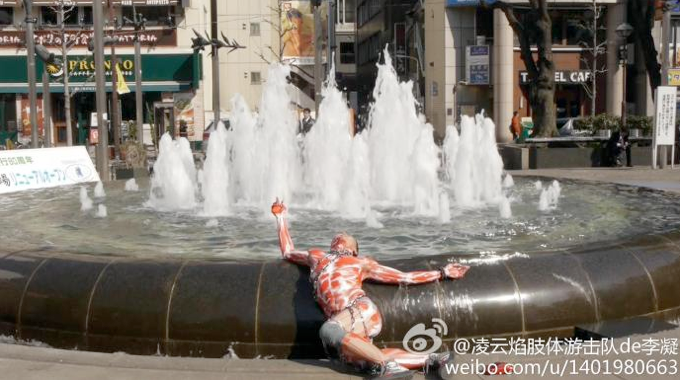
When r:ead’s first period of stay finished and I returned to China, the relations between China and Japan were very tense. As an artist with ambition, I thought that I could make use of this situation to make a performance. I wanted to leave my mark on history and art history. At this time, I was a bit silly! I thought it was enough to just stir up sensations, no matter whether the idea was right or wrong, whatever the result was. You could say that the beginning of the film depicts my true inner state. I, a Chinese national, a young man of patriotic mind, would create a performance at the Yasukuni Shrine and irritate “Japan” – hoping to provoke. But what I saw after I had arrived in Japan was a pretty city, and Japanese people working hard and devotedly, and enjoying their lives. Many Japanese also do not conform to their government, a fact that gave me a positive impression of Japan. By this, my general idea of “Japan” that had been vague, unsophisticated and abstract, dissolved, while a concrete interest in individuals arose. And “I” gradually lost my goal. By coming into contact with more and more Japanese people, from elderly people who experienced the war to pure youth, I realized that all of them have thoughts that are intense. This is due to the strength of education. During the war and today, education has always been consciously and constantly controlled by the state or the government, especially in times when the content of the education is questionable. An 88-year-old man said that he does not like China. But this is because he was taught in school that China is a bad country and that the Chinese are lesser beings. Some 13-year-old boys said that they did not know much about the Sino-Japanese War. Behind the educational system stands the control of the state. I gradually opened my eyes. It is not that the Japanese are brutish, but that all humans have a brutish side, a madness. They are controlled by the state which utilizes them at those points where their humanity is weakest. A countless number of citizens are lost in the hell that is war…

When I was watching a performance by Butoh master Min Tanaka, I was utterly lost in contemplation. Because Tanaka’s body and my own body are so similar, I felt as if I had been on stage myself. I could see myself in twenty years’ time.

The Red Army soldiers during the Cultural Revolution did not at all differ from the Japanese Imperial Army. Talking to my mother, she told me about the time when she, as a member of the Red Guards, saw Chairman Mao on Tiananmen Square. “We were also following the doctrine of Mao Zedong passionately and we did brutal things.” By reading over several documents, I learned that many historical facts had been hidden by the Chinese government, such as the Sino-Japanese War. The Kuomintang initiated the war, which led to tragedy, but in the anti-Japanese TV dramas that are broadcast today one after the other on Chinese television, the narrative has it as only the Communist and guerilla armies attacking the invading Japanese army. What has the present Chinese government given the Chinese people? Pollution, forced evictions, fraud, brainwashing… By this time, my ambition and wish to become “famous” had already collapsed…I don’t want to be an accomplice in a state crime, I don’t want to become a marionette of the government. To start with, I gave up my plan to perform at Yasukuni Shrine. The choice of this place is not my own unique style of expression; I would merely be a tool of the government. Instead, I would do a performance in an ordinary part of the city for regular people – with a different topic and in a different style. This is the force of my art, this is the artistic approach I chose.

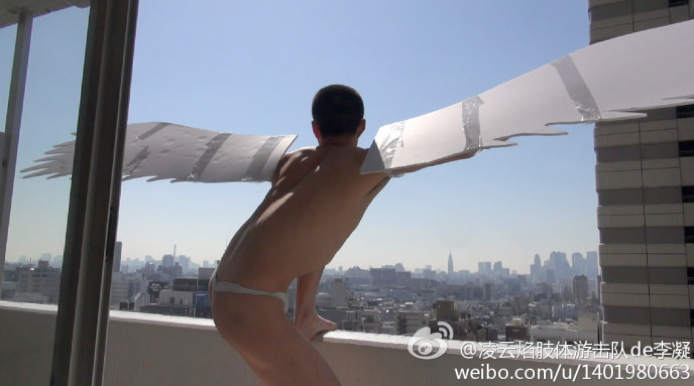
“The Chinese and Japanese people, don’t let somebody turn you into a marionette!” For the final scene, as a symbol of freedom I fitted myself with wings, standing on top of a high-rise building in Tokyo, looking up at the sky and the city below.

“History will probably not remember me. But what is ‘history’? It is something created by the victors. What we really need is clean air and food.”

The film is shot from a first-person perspective and tracks the real-time changes of my mental state, but the viewers can also easily synchronize themselves with it. For me, it is very meaningful to create a work like this, especially with the current situation between China and Japan so tense. I hope that I can contribute a little to the “undoing” of prejudices and misunderstandings between nations, to the interaction of individuals, and to the search for self-reflection and sincerity which lie in human nature.

During the creation process in Tokyo, I received great support from many people, including Hitomi Oyama, Shiryu Kyo, Ulrike Krautheim, Kaori Yoshizaki, and Chiaki Soma. Thank you very much.
First Experience: Ning Li – In Search of the “Changeling” in Tokyo

When the artist Ning Li came to Tokyo, he brought with him the characteristic dustiness of his hometown Jinan, as well as the psychic stress, the discouragement, anger, and resignation of life particular to the current government of China.

For a Chinese national today, “Japan” is no doubt the emblem they know best. The thoughts towards Japan that Chinese people have refer to the war that took place 1937 and 1945. In films and television dramas, the image of the “Onigo” (“changeling”, a pejorative term for the Japanese) has taken society by storm and gradually implanted a stereotype into people’s minds. (In the past, “Onigo actors” were skinny Chinese actors playing the roles as vulgar characters but recently it has been more young Japanese actors who live in China.) Ning Li has been searching for the “Onigo” in Japan, but the only people he could find are people diverse in sensibiltiies and personality, and who have the same human emotions as him. The stereotype he had in his mind has lost its shape. At this point he then developed his concept of “Undoing”.

Naturally, the structure of the work is relatively simple but in the current situation between China and Japan, a work like this is experiencd in a very particular way. Ning Li, as he shows in the beginning of the work, ironically points to an empty, narrow-minded Chinese nationalism. His perspective, though applying different methods, also represents an ironical parallel with Makoto Aida’s approach to Japanese nationalism.

The categories of “state”, “ethnic group” and “race” are “undone”, and the position of the individual strengthened, so that the individual is not absorbed by the group any more.

There is a popular funny story. The theme for a short essay in an English exam was: “Write about your personal view on the problem of food deprivation”. The African students asked: “What is food?” The American students asked: “What is deprivation?” And the Chinese students asked: “What is a personal view’”? In China, where collectivism is esteemed, individual principles are systematically destroyed by the educational system, ideology and habits. As an artist who is living under the strong pressure of this system we can understand that Ning Li is rebelling. Looking at his initial works, its form is comparably simple and superficial. But this is no doubt due to the fact that there have been limits of time and scale. Yet what is even more important is that his theme is the collapse of the group, the wiping out of stereotypes and categories, but his research and its methods still rely on categorization. This means that when he decides on the age of the interviewees for his film he expects that these person will be representatives of his or her age group. For example, he asks: “How are you Japanese thinking about this issue?” “You Japanese junior high school boys, what do you like?” When he asks questions like this, he wants the interviewed person to answer as a representative of the group to which he or she belongs, and the questions undoubtedly include a kind of induction. By this, a precious opportunity for true exchange between individual and individual becomes ineffective; the interviews remain on the surface. And this is contrary to the artistic aim of Undoing. Without the limitation of time, Ning Li’s interviews would surely have come reached a higher standard.

Actually, since the 1980s Chinese artists have emphasized the role of the individual and worked to weaken collectivism. The dark shades of the civil movements during the Cultural Revolution still continue to shroud people’s minds. The pressure of mainstream discourse under the current system created a backlash which made Chinese contemporary art of the last thirty years opposed to the issues of social responsibility and the politicization of art. Ning Li’s way of thinking basically follows this same track. It is like a hand-me-down opinion from the 1968 student movements in the West, but when we take the specific circumstances in China into account, we can say that this kind of resistance can still claim value.

The foremost aim of r:ead is exchange. The very first unconscious step of cultural exchange is to escape from stereotypical images and to eliminate the prejudices against certain ethnic groups, and to deal with each other, individual to individual. In this way, deepening the exchange between individuals, deeper thinking will finally be generated. More than thirty years have passed since the policies of reform and openness began. China is still a relatively closed state. Especially for a Chinese artist r:ead was a most valuable experience.

History Repeated by Democracy II – Resetting History

During the second period of stay I brought up the topic of how history had been repeated due to democracy. I did so because the date of the final presentation was March 11th, 2013. On that same day in 2011, a part of Japanese history was reset, and many things were planned and valued anew from March 12th. And then in the 2012 lower-house election, Shinzo Abe was elected prime minister once again. Five years ago in 2007, when he was prime minister, March 11th had been just an ordinary day.

For my presentation, I prepared newspaper editions from March 11th, 2007 – the Asahi Newspaper, the Mainichi Newspaper, the Yomiuri Newspaper and the Nikkei Newspaper. I divided my presentation into two parts: The newspapers were first exhibited and then later read out by the attendees. The participants read the name of the newspaper, the date and article chosen by themselves. Through this, March 11th, 2007, was repeatedly emphasized, bringing to the fore little by little the difference between the years. For example, in international politics at that time, America was still under the Bush regime, mobile phones were a comparatively older design, and advertisements for construction companies were still full of hope. Questions were also raised about resolutions for the issue of the wartime comfort women and the attitudes of China.

When I heard the people reading out the texts, I not only felt a kind of nostalgia, I was also astonished how many things I had forgotten. We tend to think our memory is perfect when we evaluate things, but this is a strange thing to think. Nobody knows what he or she was doing five years ago on a certain day.

On March 11th, 2011, a part of Japanese history was reset, but this sort of resetting is exactly what art creators have to attempt to do in their work. They can pull audiences into a situation, where planning and evaluation are conducted anew and the creators themselves are reset every time, collecting new material and then engaging with the next work. Through the residency, the artists and curators were “reset” to a certain extent. Due to this I hope for dialogue on what kind of new works they will create in the future.